
By Building Type
How to build a backyard office you can use year-round
Insulation, power, internet and light — the four things that separate an office from a shed with a desk in it.
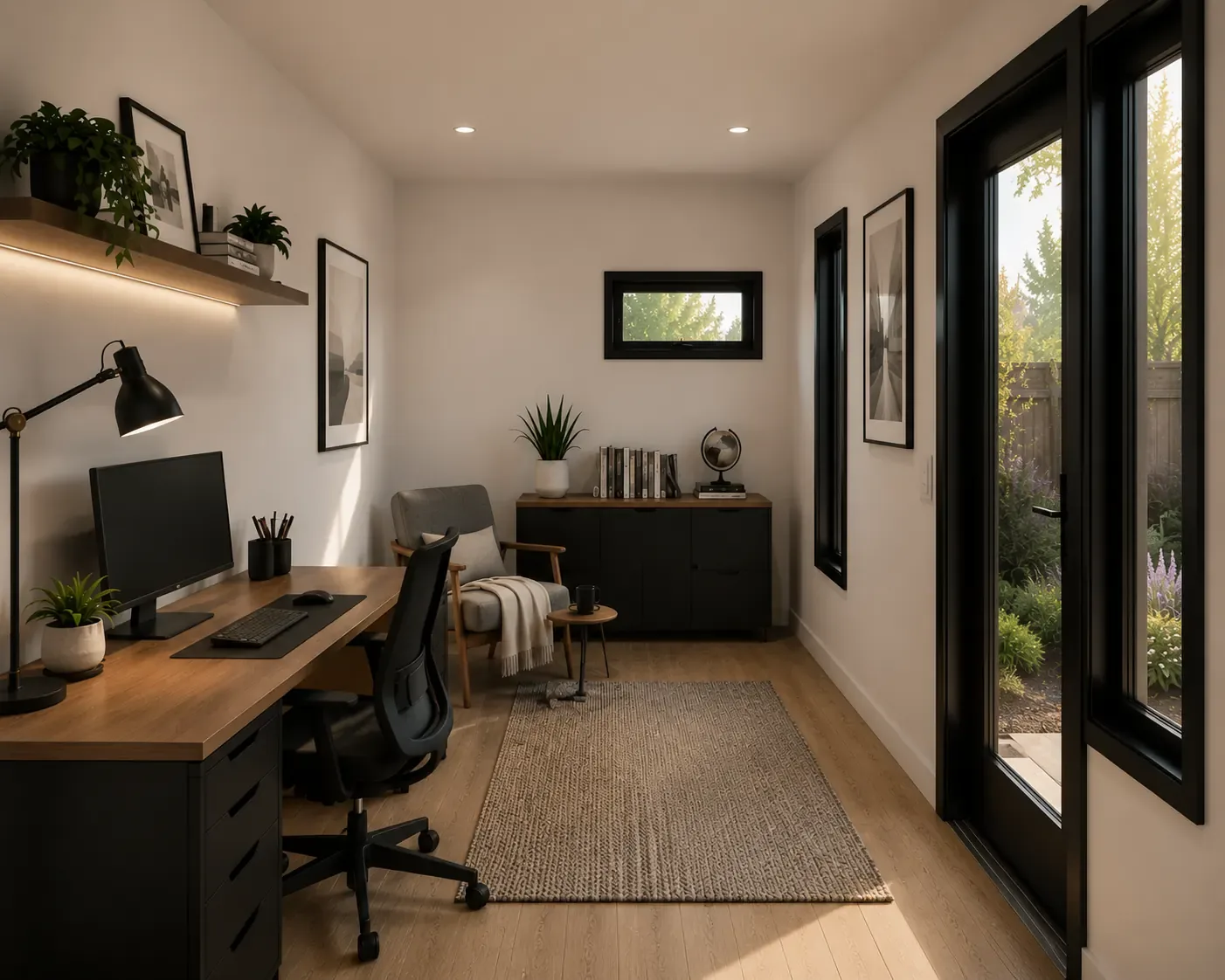
The difference between a building you use in October and one you use in January is not square footage or styling. It comes down to four things: insulation, power, connectivity and light. Get those right and a 100-square-foot building is a genuine office. Get them wrong and it is a shed with a desk in it.
Insulation, and the vapor barrier nobody mentions
Choose insulation and moisture control for your climate, intended use and adopted energy code. Review the assembly specified in your selected plan with a local professional; a single R-value or vapor-barrier placement is not appropriate for every climate.
The vapor barrier is the part that gets skipped, and it is the part that causes trouble. Warm, damp air from inside meeting cold sheathing produces condensation inside the wall, and condensation inside a wall produces rot you will not see until it is expensive. Install it as drawn.
Do not neglect the floor. An uninsulated floor over a pier foundation is a large cold surface directly under your feet, and it is the single most common reason a well-built backyard office still feels cold.
Power: do it once, properly
Work out your actual load before you call anyone. A typical setup wants:
- A computer, one or two monitors and peripherals
- Task and overhead lighting
- A small heater or a mini-split heat pump — by far the largest draw
- Incidentals: a kettle, a phone charger, a speaker
That adds up to more than a single extension lead should ever carry. A dedicated circuit from your main panel, run by a licensed electrician, is the right answer, and in most jurisdictions it needs its own permit and inspection regardless of whether the building itself needed one.
Internet that holds up on a call
Wi-Fi from the house through two exterior walls is the most common disappointment in a backyard office, and it degrades sharply past about 30 to 40 feet.
| Option | Reliability | Notes |
|---|---|---|
| Buried ethernet cable | Best | Trench it alongside the electrical run while the ground is open |
| Outdoor mesh access point | Good | A solid fallback where trenching is impractical |
| House Wi-Fi as-is | Poor past ~30 ft | Fine for email; unreliable for video calls |
If you are trenching for power anyway, the marginal cost of dropping a network cable in the same trench is small, and it is the version you will not have to revisit.
Light
North-facing glazing gives soft, even daylight with no glare on a screen — which is why the Garden Studio's picture window is placed as it is. Add warm-white overhead lighting for the darker months and a task lamp at the desk, and the space reads as a room rather than an outbuilding.
Avoid putting a monitor directly in front of a bright window. Working against a backlit view is tiring, and it is a surprisingly easy mistake to design in.
Choosing a size
For one person with a desk, a chair and storage, 10 × 10 or 10 × 12 is comfortable. Move to 12 × 16 if you need a second work position, a meeting chair, or separation between working and everything else. All three sizes of the Garden Studio are drawn for year-round use, with the same insulation specification throughout.
Common Questions
Frequently asked questions
- How much insulation does a backyard office need?
- The required insulation depends on climate, intended use and your locally adopted energy code. Review wall, roof and floor assemblies together, including air sealing and moisture control. Confirm the selected plan’s specifications and any local changes before construction.
- Can I run an extension cord to my backyard office?
- Not as a permanent arrangement. Once you add heating or cooling, the load is well beyond what an extension lead should carry. A dedicated circuit from your main panel, installed by a licensed electrician, is the correct solution and usually requires a permit.
- How do I get reliable internet in a backyard office?
- A buried ethernet cable, ideally trenched alongside the electrical run while the ground is already open, is by far the most reliable option. An outdoor mesh access point is a reasonable fallback. Relying on house Wi-Fi through exterior walls is unreliable past roughly 30 to 40 feet.
- Is a backyard office warm enough in winter?
- Yes, when it is insulated to specification, has a vapor barrier and an insulated floor, and has a heat source on a dedicated circuit — commonly a mini-split heat pump, which handles both heating and summer cooling.
Keep Reading
Related guides
How much does it cost to build a backyard office?
Real per-square-foot ranges, what drives them, and how to turn a material list into a budget.
Do you need a permit to build a backyard office or shed?
Size thresholds, the questions to ask your building department, and what a permit desk wants to see.
Where to put a backyard office: sun, drainage, access and setbacks
Position is the one decision you cannot revise after the foundation goes in.